Bristol type 3: a sausage with cracks (and yes, that's normal)
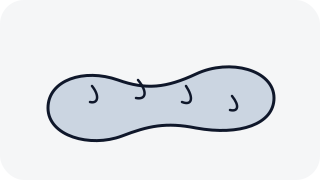
Short answer: type 3 is normal. The NHS England Bristol stool chart puts types 3 and 4 together as what healthy poo looks like. The cracks only mean it’s a little firmer than type 4. So the real question isn’t “is this OK?” but “is this my usual, and has anything else changed?” That’s what this page helps you check.
What does Bristol type 3 look like?
The NHS England chart says “like a sausage but with cracks on the surface”. It holds its shape, comes out in one or a few pieces, and passes without much effort.
Why does my poop have cracks on it?
Poop loses water as it moves through your large intestine. A few cracks mean it’s a shade drier than smooth type 4, but not so dry that it breaks into lumps. The Bristol scale was checked against measured gut transit in a 1997 study of 66 volunteers: as transit slowed, stool form moved toward the hard end. Type 3 sits comfortably in the middle.
Type 3 vs type 2 vs type 4
| Feature | Type 2 | Type 3 | Type 4 |
|---|---|---|---|
| NHS England wording | Sausage-shaped but lumpy | Like a sausage but with cracks on the surface | Like a sausage or snake, smooth and soft |
| Surface | Lumpy, knobbly | Cracked | Smooth |
| Usually passes | With effort | Easily | Easily |
| What it suggests | Slow transit, constipation | Healthy range | Healthy range |
A quick way to tell 2 from 3: if you can see separate lumps pressed together, it’s type 2. If it’s one piece with cracks, it’s type 3.
If type 3 is normal, why track it?
Because your normal is your baseline. Most changes worth noticing are changes from what’s usual for you. The NHS bowel cancer guidance talks about changes that aren’t usual for you, and the NHS bleeding page says to see a GP if your poo has been softer, thinner or longer than normal for 3 weeks. You can only spot that if you know what normal looked like.
A baseline week of mostly type 3 also gives you something to compare against when you change your diet, start a medicine or travel.
What you might notice, what it can mean, when to get checked
| What you might notice | What it can mean | When to get checked |
|---|---|---|
| Type 3 most days, easy to pass | Healthy range | No action needed |
| Type 3 shifting to type 2 over a week | Less fiber, fluid or movement lately | Try the basics; see a GP if it continues |
| Type 3 shifting to looser types for 3 weeks | A change in bowel habit | See a GP (NHS) |
| Type 3 but black, bright red or pale | Color matters more than shape here | See the poop color chart; get help as advised there |
| Type 3 but blood on the paper | Possibly piles or a small tear | See a GP to check (NHS) |
| Type 3 but you’re losing weight without trying | Needs checking | See a GP |
What does a healthy type 3 week look like in a log?
Mon 07:45  Poop: Type 3
Mon 12:30  Meal: chicken salad, wholegrain roll
Tue 07:50  Poop: Type 4
Wed 08:10  Poop: Type 3
Wed 19:00  Meal: curry with rice and lentils
Thu 07:40  Poop: Type 3
Fri  No poop logged
Sat 09:30  Poop: Type 3
Paper note: busy Friday, skipped breakfast
This is a perfectly ordinary week. A day off and a mix of 3s and 4s is normal. Save a week like this; it’s your reference point.
How do I keep type 3 steady?
You don’t need to overthink it. The NHS basics for avoiding constipation also keep things steady:
- fiber from a mix of fruit, veg, wholegrains, beans and lentils (the NHS recommends 30g a day for adults; see fiber)
- plenty of fluids
- daily movement
- going when you feel the urge
Type 3 myths vs facts
| Myth | Fact |
|---|---|
| Only type 4 is healthy | The NHS England chart groups 3 and 4 together as healthy poo. |
| Healthy means pooping every day | Fewer than 3 a week is the usual constipation marker (NIDDK). Daily isn’t required. See how often should you poop. |
| A normal shape means nothing’s wrong | Shape doesn’t rule out bleeding or other changes. Color, blood and weight loss still matter (NHS). |
| Green poop is a problem | Mayo Clinic says shades of brown and even green are considered typical. |
How do I talk to a doctor if my poop looks normal but something feels off?
Say exactly that. “My poop is usually type 3 and still is, but I’ve noticed blood on the paper twice this month” is clear and useful. Bring your log, your medicines and supplements, and when the change started. Our GI appointment checklist helps.
Your baseline in 3 steps
- Log every poop's Bristol type for 7 days
- Note how often you went and any days with none
- Keep that week as your normal to compare against later
Where does PoopAI fit?
PoopAI is handy for building that baseline. Log each poop as Bristol type 1 to 7, with an optional photo, and meals by photo or text. The weekly report and trend charts show your usual mix of types, so a shift stands out. It doesn’t diagnose, and it doesn’t log symptoms.
The bottom line
Type 3 is healthy. Keep doing what you’re doing, learn your usual pattern, and get checked if that pattern changes for weeks or a red flag appears. Next: type 4, or the gut health hub.
Editorial note: Written by The FixMyGut team using the NHS, NIDDK, Mayo Clinic and peer-reviewed sources listed below. It’s general information, not a diagnosis. Facts checked against those sources on November 5, 2026.
Sources
- Bristol stool chart (for carers) (NHS England)
- Stool form scale as a useful guide to intestinal transit time (Lewis & Heaton, 1997) (PubMed)
- Constipation (NHS)
- Symptoms & Causes of Constipation (NIDDK (NIH))
- Bleeding from the bottom (NHS)
- Stool color: When to worry (Mayo Clinic)
- Symptoms of bowel cancer (NHS)
- How to get more fibre into your diet (NHS)
Last reviewed 2026-11-04
FixMyGut is not affiliated with or endorsed by the NHS, NIH, NICE, Mayo Clinic or Monash University.
Related reads
Quick answers
Is type 3 poop healthy?
Yes. The NHS England Bristol chart points to types 3 and 4 as what healthy poo looks like.
Why does my poop have cracks?
Cracks show it's slightly firmer and drier than a smooth type 4. It's still in the healthy range. If it gets lumpier and harder to pass, you're moving toward type 2.
Is type 3 or type 4 better?
Both are in the healthy range on the NHS England chart. There's no need to chase type 4 if type 3 is easy for you to pass.
How often should I have type 3 poop?
There's no set number. NIDDK and the NHS use fewer than 3 poops a week as a constipation marker. What's usual for you matters most.
Can type 3 poop still be a sign of something wrong?
Shape alone doesn't rule things out. The NHS says to see a GP for blood in your poo, weight loss without trying, or poo that's been softer, thinner or longer than normal for 3 weeks.
What color should type 3 poop be?
Mayo Clinic says all shades of brown, and even green, are considered typical. Black, bright red or pale poop needs attention whatever the shape.

Download PoopAI
Free to try. Log your next poop and meal in under a minute, then let the weekly report do the pattern-spotting.